There is no single number
Ask what a Shako is worth and you will get five answers, all of them right.
The honest answer to "what is my item worth" is a range, in a currency, for a specific market, at a point in the season, for the copy you are holding. Every reliable price source encodes all of that. Almost none of them explain it.
That is what the rest of this page does. By the end, a rune ratio guide or a tier list will read differently, because you will know what it is leaving out.
The currency
Runes are the money. Diablo II has gold, and gold is worthless for trading. The economy runs on runes. Mid runes like Pul, Um, Mal and Ist change hands as currency, and high runes like Ber and Jah are the large bills.
Ist is the unit of account. When players quote a price, they quote it in Ist, the way a market quotes in dollars. "That amulet is 3 Ist" is a complete sentence to a D2R trader. Everything on this page uses Ist for that reason.
Runes do not trade at cube ratio. You can cube three of a rune into one of the next rune up. That does not mean three Ist are worth one Gul. Some cube steps roughly hold their value. Others destroy it, because demand for the higher rune is nowhere near three times the demand for the lower one. Never assume the cube recipe is the exchange rate.
Published ratios disagree, and that is the lesson. Look at any three rune value guides from this year and you will find Lo quoted anywhere from 10 to 14 Ist, and Ber anywhere from 22 to 34. Those spreads are not typos. Each guide is a snapshot of a different market at a different week. A static list is already wrong by the time you read it.
Those figures are illustrative, as of mid 2026, and are not a price for anything. They are here to show the spread, not to trade against.
Forum Gold is a parallel currency. On d2jsp, players trade with Forum Gold, a site currency that is independent of any game account or platform. Some price tools quote in FG rather than Ist. The two currencies drift against each other, so a price in one is not a simple conversion of the other.
The markets are walled
Your Ist and a stranger's Ist may not be the same Ist.
Diablo II Resurrected has cross-progression, so your own characters follow you between platforms. It does not have cross-platform trading. A PC player and a Switch player cannot meet in a game to trade. The only way an item crosses that line is if its owner has the game on both platforms and walks it across through cross-progression. That happens, but not at a scale that joins the markets. A PC Ist and a Switch Ist stay different goods, with different supply and different demand.
Then split each platform again:
- Ladder or Non-Ladder. Ladder resets each season, so its economy starts from nothing and everything is scarce. Non-Ladder accumulates forever.
- Softcore or Hardcore. Hardcore has fewer players, fewer items, and a different appetite for defensive gear.
- Online or Offline. Offline single player has no market at all. Nothing has a trade value there, only a use value.
Stack those up and the same item lives in eight or more separate economies, each with its own price. A value list that does not say which one it is describing is describing none of them.
Prices move through the season
The same market changes shape from reset to reset.
Early season. Everyone is poor. Mid-tier uniques that carry a character through Nightmare and early Hell hold real value because nobody has better yet. High runes spike, because they are rare and the runewords that need them are the fastest way to power.
Mid season. Builds are finished. Demand shifts to endgame uniques, premium runewords, and the small margins: good charms, well-rolled rares, perfect jewels. The mid-tier uniques that were valuable in week one are now dropping for free.
Late season. Values soften. People stop farming for trade. Ladder prices drift toward Non-Ladder prices, and everything waits for the next reset.
A price from week two and a price from week twelve are prices for two different items.
Asking prices lie
Open any trade listing site and you are looking at what sellers hope to get.
Listings are inflated on purpose. They get bumped for weeks. Many of them never sell at that number, or at all. If you price your item against the asking prices you can see, you will overvalue it, and then wonder why nobody bites.
The reliable signal is completed trades: what people actually paid, for that item, recently, in your market. That is the one number that means something, and it is the one number most value lists do not show you.
If you take one thing from this page, take that.
Averages lie too
Even with completed trades in hand, the average is the wrong number.
A handful of overpriced trades drag the mean up from one side. A rare perfect roll that sold high drags it up from the other. A few desperate quick sales pull it down. The average lands somewhere nobody actually traded.
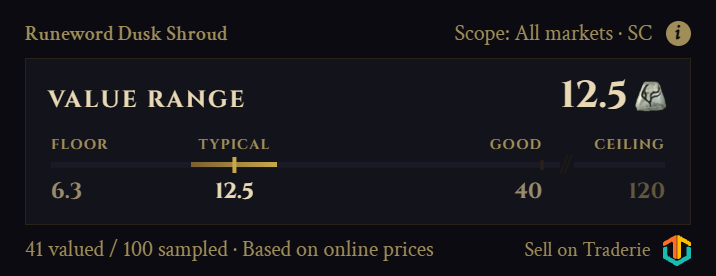
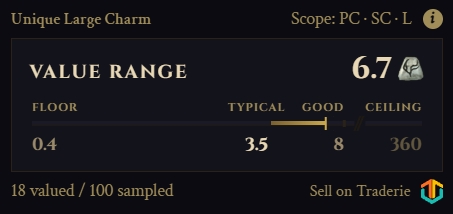
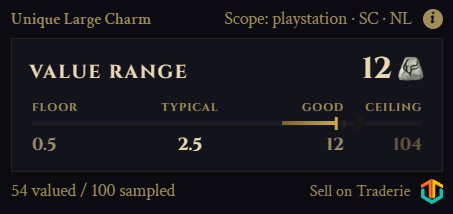
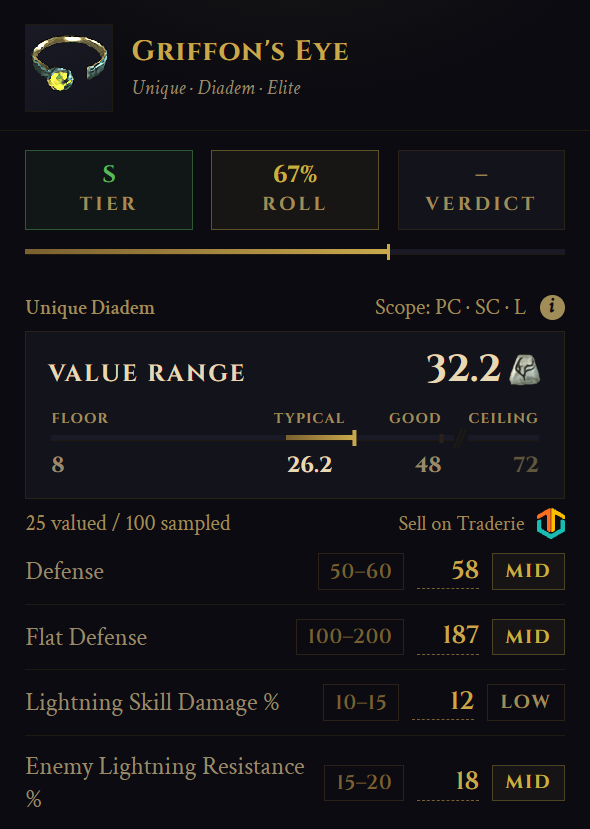
What you want is the shape of the range:
What the item fetches on a bad day, with a poor roll, sold fast.
The typical price for a typical copy.
The price a strong roll earns above typical.
What a perfect copy has actually sold for.
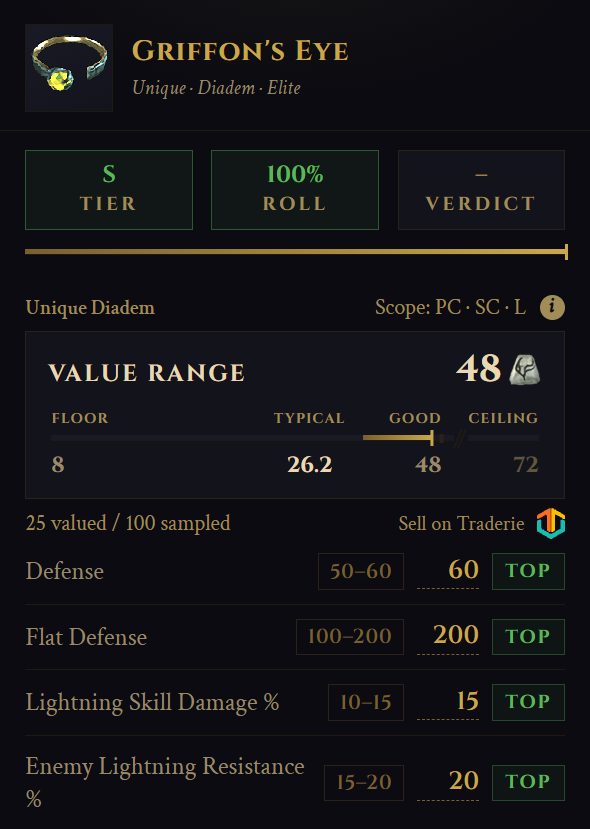
Knowing where your copy sits in that spread tells you what to ask, what to accept, and when to walk. A single number cannot do any of that.
Identical items are not identical
Two copies of the same unique can differ in value by ten times. Four things do it.
Roll quality. Most items have variable stats. A Shako can roll +1 or +2 skills. A Fortitude can roll 25% or 30% all resistances. The market prices the roll, not the name. A perfect small charm against a merely good one is a large multiple, not a small premium.
Ethereal. An ethereal copy has more defense or damage and cannot be repaired. Mercenary gear never loses durability, so an ethereal armor, helm or polearm on a merc is pure upside, and ethereal merc pieces are sought after for exactly that reason. The same goes for anything that will get a Zod rune or is indestructible by design. For a helm you plan to wear yourself through three acts, ethereal is a discount. Same item, opposite direction.
Sockets. A socketed copy lets you add a rune or jewel. An unsocketed copy does not, unless you spend a quest reward or a cube recipe on it. The socket count on a runeword base is the whole price.
The base, for runewords. A runeword's value is the cost of its runes plus a premium for the base it went into. A Grief in a Phase Blade, a Berserker Axe, and a Colossus Blade are three different prices. The same runes went into all three.
Rares and crafts have no database entry
Uniques have a name. You can look a name up.
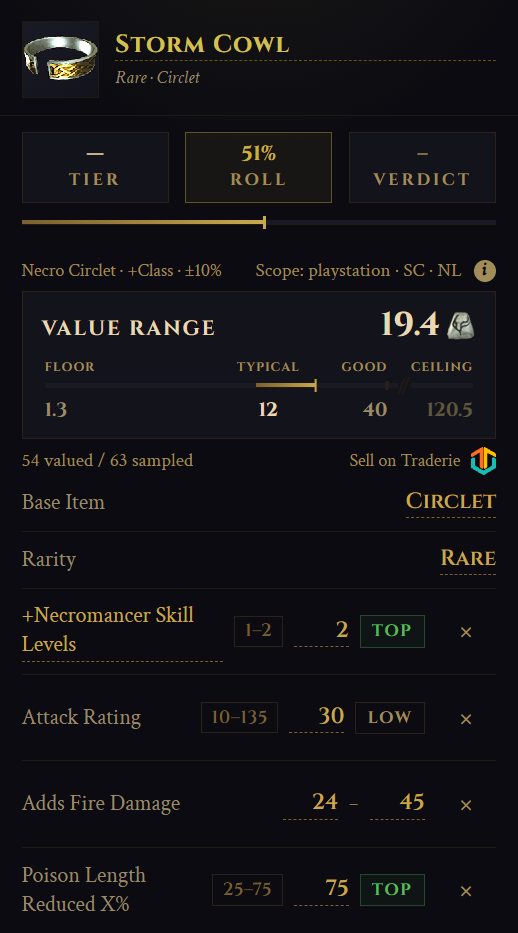
Rares and crafted items have a randomly generated name and a random set of affixes. There is no entry for "Soul Clasp" anywhere, because yours is the only one. Its value comes from reading each affix, knowing what each one rolled against its possible range, and knowing which combinations a build actually wants.
This is why lookup tools go quiet on rares and crafts. It is also why they are the hardest items in the game to price, and the ones most often sold for far less than they were worth.
Packmaster reads rares and crafts the same way, affix by affix against each one's range, which is why it can score a rare as readily as it scores a unique.
Keep, trade, or vendor
Value is only half the question.
If a character on your account can wear it now, or if it is an upgrade over what one of them has equipped. An item that makes your Hammerdin faster is worth more to you than any Ist it would fetch.
If nobody on your account can use it, but completed trades show it moves at a price worth your time. A good drop for a class you do not play is currency, not clutter.
If it is neither. Most drops are vendor trash. Saying so out loud, and acting on it, is the difference between a stash you can use and a stash you cannot find anything in.
The hard part is that the answer depends on what you already own. A Grim Talisman is a keep for an account with a caster and no good amulet, and a trade for an account that already has a better one on a mule you forgot about.